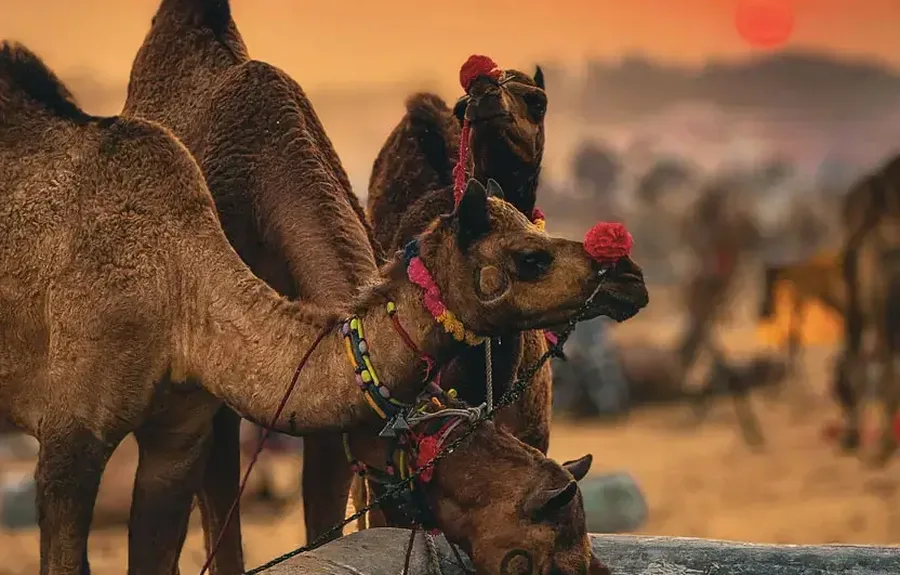
Delhi - Mandawa - Bikaner - Jaisalmer - Jodhpur - Udaipur - Bundi - Jaipur
A full fortnight lets Rajasthan unfold in the right order, from the painted merchant towns of the north to the golden sandstone of the Thar Desert and the green lake country of the south. The 14 Days Rajasthan Tour Package from Delhi covers 13 nights and eight destinations: Mandawa in Shekhawati, the camel city of Bikaner, the living fort of Jaisalmer with a night under the stars at the Sam dunes, Jodhpur below Mehrangarh, Udaipur on Lake Pichola, the quiet stepwell town of Bundi and finally Jaipur. Distances between stops are kept to five or six hours at most, with two-night stays where there is most to see.
The whole tour runs in a private air-conditioned car with a dedicated English-speaking driver, which means you can stop at village wells, roadside temples and camel fairs whenever something catches your eye. Local guides join you in each city. The route ends in Jaipur with a gentle morning at the Elefantastic elephant sanctuary, where rescued elephants are fed, walked and bathed rather than ridden. For a shorter version, see our 10 Days Rajasthan Tour Package from Delhi, or compare the slower Complete Rajasthan Tour among our Rajasthan tour packages.
Package Highlights
• Painted havelis and frescoed streets of Mandawa in Shekhawati
• Junagarh Fort, the Karni Mata temple and a camel research farm in Bikaner
• Living fort, Jain temples and sandstone havelis of Jaisalmer
• Camel ride at sunset and a night in a desert camp at Sam Sand Dunes
• Mehrangarh Fort and the blue lanes of Jodhpur
• Ranakpur Jain temple, Udaipur City Palace and Lake Pichola
• Stepwells and murals of Bundi
• Elephant morning at Elefantastic and the forts of Jaipur
Welcome to India. As you step out of the arrivals hall at Indira Gandhi International Airport, our representative greets you with a sign showing your name and introduces you to your driver, who will be your companion for the next two weeks across Rajasthan. The car is air-conditioned, spacious and stocked with bottled water. The drive to your hotel in central Delhi takes 45 minutes to an hour. Many flights arrive at night, and we track every arrival so that your pickup always matches your real landing time.
Check in at your hotel, usually from 2:00 pm, or straight away if you have booked the room from the night before. The day is free for rest after the long flight. If you feel like a short outing, your driver can take you to Humayun's Tomb, the 16th-century Mughal garden tomb that inspired the Taj Mahal, or to the open lawns around India Gate for an evening stroll. Most guests prefer to keep the first day quiet, though, as the drive into Rajasthan starts tomorrow morning and the first stop is about five to six hours away.
Our coordinator meets you in the evening to go through the whole route, hand over your vouchers and a 24-hour helpline number, and answer any questions about the coming days. Over 14 days you will cover around 2,000 km, so we have kept the longest drives to five or six hours with comfortable breaks. Desert nights in Jaisalmer can be cold from November to February, so pack a warm jacket along with light cotton clothes for the days. A head scarf is handy for temples and the Sufi shrine in Ajmer. Overnight stay at your hotel in Delhi.
After an early breakfast, drive about 260 km west to Mandawa, a drive of five to six hours through the farmland of Haryana and into the Shekhawati region of northern Rajasthan. The road passes small towns, mustard fields and camel carts, and your driver will stop for tea at a roadside dhaba. Shekhawati was once home to wealthy Marwari merchant families, who made their fortunes in trade and built grand mansions, called havelis, covered with painted murals. Today, the region is often called the open-air art gallery of Rajasthan.
Arrive in Mandawa in the early afternoon and check in at your hotel, which may be a restored castle or haveli. After lunch, your local guide leads you on a walk through the town's narrow lanes to see the painted havelis. The walls show colourful scenes of gods, kings, elephants and horses, as well as surprising images of trains, cars, aeroplanes and British officers, painted in the 19th and early 20th centuries when the merchants first saw these new inventions. The Goenka, Chokhani and Murmuria havelis are among the finest examples.
In the late afternoon, visit the Mandawa Castle, built in 1755, and climb to its terrace for views over the town and the surrounding sand. Many havelis are still lived in by caretaker families, and a small tip is customary when you are shown inside. As the sun sets, the town grows quiet, and you can enjoy dinner on a rooftop under the stars. Mandawa is a peaceful place to spend the night, far from the traffic of big cities. If you enjoy this region, our Golden Triangle Tour with Mandawa Heritage Town covers it with the Taj Mahal. Overnight stay at your hotel in Mandawa.
After breakfast, drive about 190 km west to Bikaner, a drive of around three and a half hours. The landscape becomes drier as you move deeper into the Thar Desert, with sand dunes, thorny khejri trees and herds of camels and goats. Bikaner was founded in 1488 by Rao Bika, a son of Rao Jodha of Jodhpur, and it grew rich as a stop on the old caravan routes between Central Asia and the Gujarat coast. Today, it is known for its fort, its camels and its famous bhujia, a spicy fried snack sold all over India.
In the afternoon, your guide takes you to Junagarh Fort, built between 1589 and 1594 by Raja Rai Singh, one of the few major forts in Rajasthan not built on a hilltop. Its plain red sandstone walls hide some of the most richly decorated palaces in the state. Inside, the Anup Mahal is covered in gold leaf and red lacquer, the Phool Mahal is decorated with mirrors and paintings, and the Badal Mahal has walls painted with blue clouds and rain, a rare sight in this dry land. The fort museum displays weapons, palanquins and a First World War biplane.
In the late afternoon, drive about 30 km south to the village of Deshnoke to visit the Karni Mata Temple, famous across India for its thousands of sacred rats, known as kabbas, which are believed to be the reincarnated descendants of the goddess Karni Mata. Pilgrims feed them milk and grains, and spotting one of the rare white rats is thought to bring good luck. Shoes must be removed, so wear socks. Return to Bikaner in the evening and try bhujia and rasgulla from the old city sweet shops. Overnight stay at your hotel in Bikaner.
Start the morning at the National Research Centre on Camel, about 8 km from Bikaner, the only centre of its kind in Asia. It breeds and studies several types of camel, and you can see hundreds of them, including young calves, in the open pens. A small museum explains the role of camels in desert life and in the Indian Army's Border Security Force. The centre's café serves camel milk ice cream and coffee, an unusual treat worth trying. The best time to visit is in the morning or late afternoon, when the camels return from grazing.
After a short visit to the Lalgarh Palace, a grand red sandstone palace built for Maharaja Ganga Singh in the early 20th century and now partly a heritage hotel and museum, set off for Jaisalmer. The drive covers about 330 km and takes five to six hours through the heart of the Thar Desert. The road is long and straight, with sand dunes, scrubland and small villages of round mud huts. You may see desert foxes, chinkara gazelles and flocks of sheep led by herders in bright turbans. Lunch is at a roadside restaurant on the way.
As you approach Jaisalmer in the late afternoon, the golden fort rises out of the flat desert like a mirage, its sandstone walls glowing in the setting sun. Check in at your hotel, ideally a heritage property with views of the fort. Jaisalmer was founded in 1156 by Rawal Jaisal, and its position on the old silk and spice routes made its merchants extremely wealthy. In the evening, enjoy dinner on a rooftop terrace with views of the illuminated fort. The desert air cools quickly after sunset, so keep a warm layer handy. Overnight stay at your hotel in Jaisalmer.
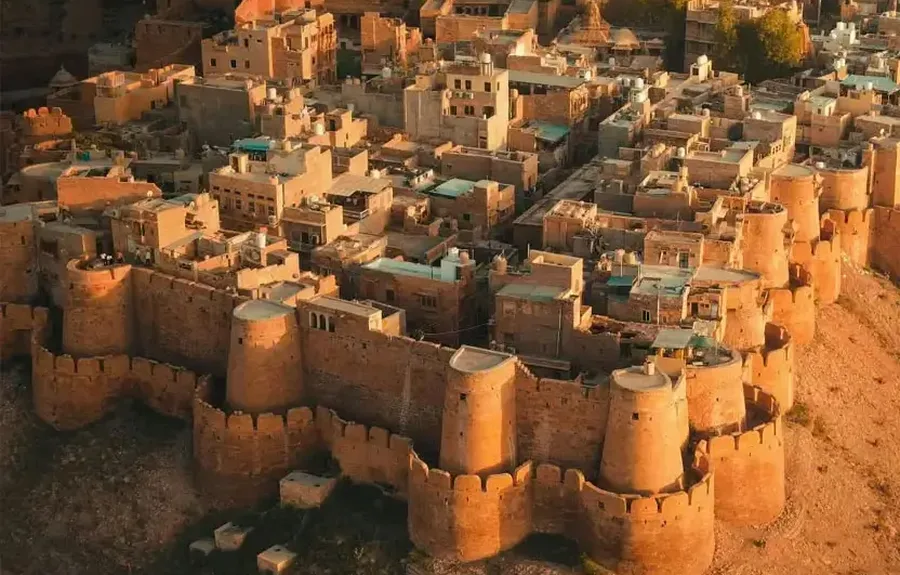
After breakfast, your guide takes you into Jaisalmer Fort, one of the very few living forts in the world, where around 3,000 people still live inside the walls. Built in 1156 from yellow sandstone, its 99 bastions rise above the town, and inside, narrow lanes wind between houses, shops, temples and small hotels. Visit the Raj Mahal, the royal palace, whose rooms and terraces offer sweeping views over the desert city. Then see the group of seven Jain temples, built between the 12th and 15th centuries, with finely carved yellow sandstone pillars, ceilings and figures.
In the afternoon, walk through the old town below the fort to see the famous havelis of Jaisalmer, built by rich merchants in the 18th and 19th centuries. The Patwon Ki Haveli is a cluster of five mansions with intricately carved balconies, windows and arches, and part of it is now a museum. The Salim Singh Ki Haveli, with its peacock-shaped brackets and blue cupola roof, was the home of a powerful prime minister, and the Nathmal Ki Haveli has carvings made by two brothers who each worked on one side, so the halves are not exactly the same.
In the late afternoon, visit Gadisar Lake, a man-made reservoir built in the 14th century, surrounded by small temples, ghats and a carved stone gateway called Tilon Ki Pol. As the sun sets, the lake turns golden, and local families feed the catfish and pigeons. You can take a short paddle boat ride on the water. Then walk back through the busy bazaar, where shops sell embroidered textiles, mirror-work cushions, camel leather goods and silver jewellery. Dinner can be enjoyed at a rooftop restaurant inside the fort. Overnight stay at your hotel in Jaisalmer.
After a relaxed breakfast, check out and drive about 6 km north to Bada Bagh, a garden complex with a group of royal cenotaphs, known as chhatris, built in memory of Jaisalmer's rulers. The carved yellow sandstone domes stand on a ridge, with wind turbines turning in the distance, an interesting contrast between old and new. Next, drive about 20 km to Kuldhara, an abandoned village of the Paliwal Brahmins, who are said to have left it overnight around 1825 and placed a curse on it. The empty stone houses and lanes are eerie and strangely beautiful to walk through.
Continue to the Sam Sand Dunes, about 40 km west of Jaisalmer, where the Thar Desert takes the classic shape of rolling golden dunes. Check in at your desert camp, which offers comfortable tents with proper beds and attached bathrooms. After lunch at the camp and some time to rest, set off on a camel ride into the dunes in the late afternoon, led by a local camel driver. The slow sway of the camel and the silence of the desert stay with most guests for a long time. Reach the top of a dune in time to watch the sun set over the endless sand.
Back at the camp, enjoy an evening of Rajasthani folk music and dance around a bonfire, performed by local Manganiyar and Kalbeliya artists, whose songs have been passed down for generations. Dinner is a traditional Rajasthani buffet served under the open sky. After the performance, take time to look up at the stars, which shine brightly in the clear desert air, far from city lights. Nights in the desert can be very cold in winter, so the camp provides warm blankets. Overnight stay at your desert camp in Sam.
Wake early to watch the sun rise over the dunes, when the sand turns from grey to pink to gold and the desert is completely still. After breakfast at the camp, set off for Jodhpur, about 300 km and five hours away. The road crosses the eastern Thar, passing small villages, grazing camels and herds of goats. Your driver can stop at Pokhran, known for its 14th-century fort, or at a roadside village where women in bright clothes draw water from deep wells. Lunch is taken at a highway restaurant along the way.
If time allows, stop at Osian, about 65 km before Jodhpur, an ancient town with a group of Hindu and Jain temples dating from the 8th to the 11th centuries. The Sachiya Mata Temple and the Mahavira Jain Temple have finely carved stone walls, pillars and doorways that are among the oldest examples of temple architecture in Rajasthan. The town is quiet and less visited, which makes it a peaceful stop. Osian is surrounded by sand dunes, and some visitors spend a night here in a desert camp, though on this tour you continue to Jodhpur.
Arrive in Jodhpur in the late afternoon and check in at your hotel, ideally a haveli in the old city with views of Mehrangarh Fort. Jodhpur, the Blue City, was founded in 1459 by Rao Jodha and is the second-largest city in Rajasthan. Its old quarter is painted in shades of blue, and the massive fort towers above it on a rocky ridge. In the evening, enjoy dinner at a rooftop restaurant with views of the fort, which is lit up beautifully after dark. Try local dishes such as laal maas or the vegetarian ker sangri. Overnight stay at your hotel in Jodhpur.
After breakfast, your guide takes you up to Mehrangarh Fort, one of the largest forts in India, rising about 125 metres above the city on a sheer rock. Its seven gates still bear the marks of cannonballs, and the handprints of royal widows who committed sati are carved by the Loha Pol gate. Inside, the palaces are richly decorated, including the Moti Mahal, the Phool Mahal and the Sheesh Mahal. The museum holds a fine collection of palanquins, howdahs, weapons, paintings and textiles. The audio guide is excellent and well worth taking.
Next, visit Jaswant Thada, a white marble memorial built in 1899 for Maharaja Jaswant Singh II, with thin marble panels that glow in the sunlight. The surrounding gardens and small lake are peaceful, and the views of the fort are lovely. After lunch, walk through the blue lanes of Brahmpuri, the old Brahmin quarter, with your guide. The narrow alleys, colourful doors and small temples give a real feel of daily life in the old city. Your guide explains why the houses were painted blue, a tradition with several local explanations.
In the late afternoon, visit Toorji Ka Jhalra, a restored 18th-century stepwell surrounded by cafés, then walk to the Clock Tower and the lively Sardar Market, where traders sell spices, textiles, vegetables and silver. Try a mirchi bada and a makhaniya lassi, two Jodhpur favourites. In the evening, enjoy dinner at a rooftop restaurant facing the illuminated fort. Tomorrow, the route continues south to Udaipur by way of the Ranakpur temple, and the second half of the tour begins. Overnight stay at your hotel in Jodhpur.
Leave the Blue City after breakfast and head south into the Aravalli hills, where the dry plains of Marwar give way to forest, streams and terraced fields. The drive of about 170 km to Ranakpur takes roughly three and a half hours, and your driver can stop at a roadside dhaba for tea and a plate of hot kachoris. Langur monkeys often sit along the road near the temple, and peacocks call from the trees. The change of scenery after a week in the desert is striking and very welcome on a long tour.
At Ranakpur, visit the Chaumukha Jain Temple, raised in the 15th century by the merchant Dharna Shah with the support of Rana Kumbha of Mewar. Non-Jain visitors are admitted from around midday until 5:00 pm, and leather goods, food and shorts must stay outside. Inside, a forest of 1,444 marble pillars, no two carved alike, holds up domes covered in lace-like patterns of dancers, flowers and musicians. Your guide points out the pillar said to lean slightly and the carving of a single body with five heads. Lunch is a simple vegetarian thali nearby.
Continue another 95 km to Udaipur, about two hours along winding hill roads past small lakes and villages. Check in at your hotel close to Lake Pichola, ideally a haveli with a terrace over the water, where you stay for two nights. In the evening, take an easy stroll along Gangaur Ghat and across the little footbridge at Chandpole, watching families feed the fish and light lamps at the water's edge. Dinner on a rooftop looking at the illuminated City Palace is a peaceful end to a long day of travel. Overnight stay at your hotel in Udaipur.
After breakfast, your guide leads you into the City Palace, a vast complex of eleven palaces built over almost four centuries by the Maharanas of Mewar, who trace their line back more than 1,400 years. Climb through narrow stairways and courtyards to the Mor Chowk, famous for its three peacocks made of glass mosaic, and the Badi Mahal, a garden courtyard built on a natural hilltop at the very top of the palace. The museum displays royal weapons, portraits and the armour of Maharana Pratap, the hero of the Battle of Haldighati in 1576.
After lunch at a lakeside café, visit Saheliyon Ki Bari, the Garden of the Maidens, laid out in the 18th century with fountains fed by gravity from Fateh Sagar Lake, lotus pools and marble elephants. Then drive up to Fateh Sagar Lake, where a short boat ride takes you to Nehru Park on its island, or simply enjoy the promenade with local families. If you like art, stop at a miniature painting studio in the old city to watch artists working on silk and paper with brushes made from a single squirrel hair.
In the late afternoon, board a boat at the City Palace jetty for a ride on Lake Pichola, gliding past the white Taj Lake Palace, the bathing ghats and the old havelis along the shore, with a stop at Jag Mandir, the island palace where the young prince Khurram, later Shah Jahan, once took refuge. Stay for the sunset over the hills. In the evening, the Dharohar show at Bagore Ki Haveli presents Rajasthani folk dance and puppetry in an 18th-century mansion on the lake. Overnight stay at your hotel in Udaipur.
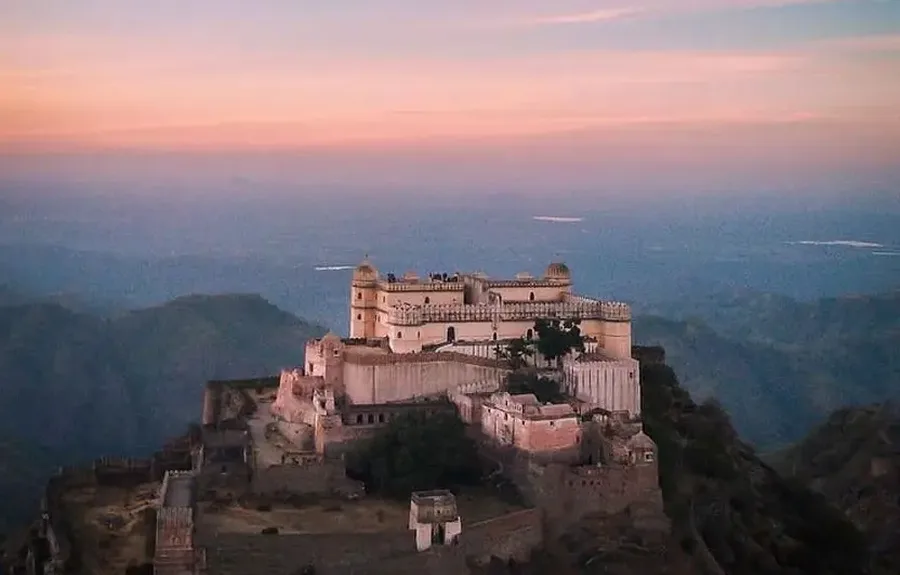
Set out early after breakfast for the long but rewarding drive north-east towards Bundi. About two hours from Udaipur, stop at Chittorgarh Fort, the largest fort in India and one of the six UNESCO-listed Hill Forts of Rajasthan, spread over about 280 hectares on a plateau high above the plains. A winding road passes through seven gates to the top, where your guide tells the stories of the three great sieges of 1303, 1535 and 1568, each ending in a final charge by the Rajput warriors rather than surrender to the invaders.
Inside the walls, see the nine-storey Vijay Stambha, the Tower of Victory raised by Rana Kumbha in the 15th century and covered with carved Hindu gods, the slender Jain Kirti Stambha, the lotus pool beside Rani Padmini's Palace and the Meera Temple, linked to the poet-saint Meerabai, who sang her devotion to Krishna in these very courtyards. The Gaumukh Kund, a spring-fed tank where water flows from a carved cow's mouth, is a cool corner on a warm day. Allow two and a half hours here, then have lunch in Chittorgarh town.
Continue for about three hours to Bundi, a small town tucked into a narrow valley below the walls of Taragarh Fort, with blue-washed houses, lakes and more than 50 stepwells. Bundi was the seat of the Hada Chauhan Rajputs and has stayed refreshingly free of crowds. Rudyard Kipling stayed here in the 1880s and is said to have drawn on its palace for his writing. Check in at a family-run haveli in the old town and enjoy dinner on the rooftop, with the palace lit up above you. Overnight stay at your hotel in Bundi.
After an early breakfast, walk up through the Hathi Pol, the Elephant Gate with its pair of carved stone elephants, into the Garh Palace, a tumble of balconies, pavilions and courtyards climbing the hillside. The highlight is the Chitrashala, a small courtyard whose walls and ceilings are covered with 18th-century murals in shades of turquoise, green and gold, showing Krishna with the gopis, royal processions, festivals and hunting scenes. They are among the finest wall paintings in Rajasthan and are best seen in the soft morning light.
Back in the old town, visit Raniji Ki Baori, a stepwell built in 1699 by Queen Nathavati, about 46 metres deep, with carved pillars, arched galleries and elephants decorating its walls. Your guide also shows you the smaller Nagar Sagar Kund twin stepwells in the market square and the cenotaph known as Chaurasi Khambon Ki Chhatri, built in 1683 on 84 carved pillars. After a light lunch in town, check out and set off for Jaipur, about 210 km and four hours away, crossing the farmland and small towns of eastern Rajasthan.
Arrive in Jaipur in the late afternoon and check in at your hotel, where you will spend the final two nights of the tour. Jaipur, founded in 1727 by Maharaja Sawai Jai Singh II and painted pink in 1876, is the capital of Rajasthan and a fine place to end a fortnight in the state. In the evening, take a short drive past the illuminated Hawa Mahal and the city gates, then enjoy dinner at a rooftop restaurant facing Nahargarh Fort on the ridge. Your driver will confirm the early pickup for tomorrow's elephant visit. Overnight stay at your hotel in Jaipur.
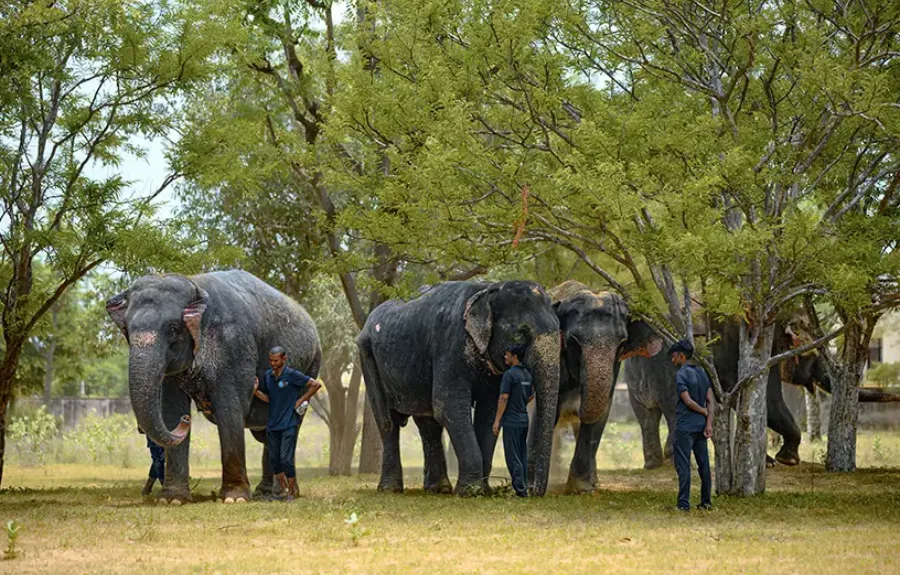
Your last full day starts with the Elefantastic team collecting you from the hotel for a day visit with elephants at their sanctuary on the edge of the city. Each guest is paired with one elephant, and the keepers explain its name, age, history and daily routine before you prepare a basket of fruit and sugarcane and feed it by hand. You then walk beside the herd through the grounds and help at bath time, splashing and scrubbing as the elephants relax. There are no rides, no chains and no shows, and the sanctuary is not in Hathi Gaon (Elephant Village).
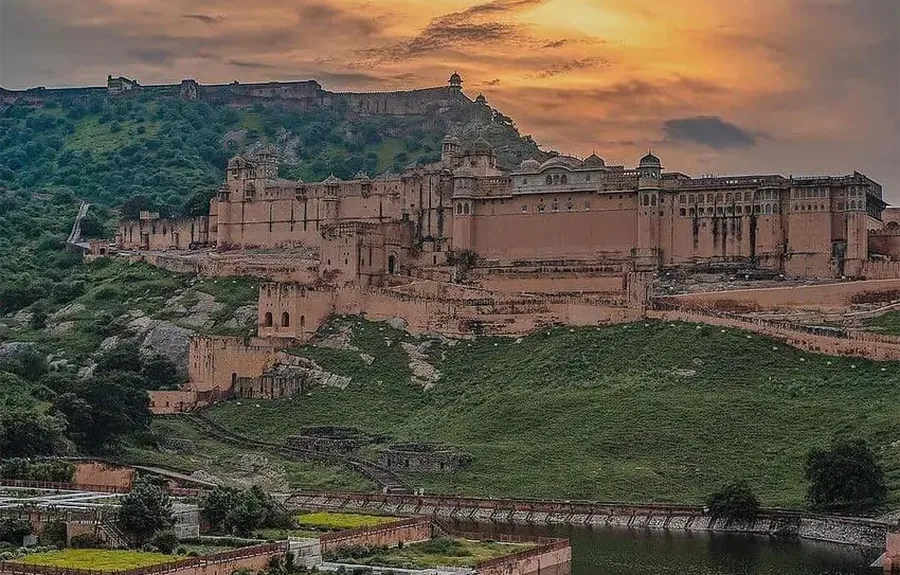
After the team drops you back, drive to Amber Fort, about 11 km north of the city, and ride a jeep up to the main courtyard. Your guide shows you the Diwan-i-Am, the painted Ganesh Pol and the Sheesh Mahal, where thousands of convex mirrors once glittered in the light of a single candle. From the ramparts, look out over Maota Lake and the long walls of Jaigarh Fort on the ridge above. On the way back, stop for photographs of Jal Mahal in the middle of Man Sagar Lake. Lunch is at a local restaurant.
In the afternoon, visit the City Palace, still home to the former royal family, and Jantar Mantar, the UNESCO-listed observatory whose giant sundial tells local time to within about two seconds. Finish with photographs of the Hawa Mahal from a café across the road, then shop in Johari Bazaar and Bapu Bazaar for block prints, silver and lac bangles. Celebrate the end of two weeks in Rajasthan with a farewell dinner of dal baati churma and laal maas at a heritage restaurant. Overnight stay at your hotel in Jaipur.
After breakfast, your driver takes you back to Delhi airport, about five to six hours by road, or to Jaipur airport for a short flight to Delhi, to connect with your international departure. For another visit, our Rajasthan Photography Tour follows a similar route with golden-hour timings.
Our assorted tours, for your first, second or nth time to India!
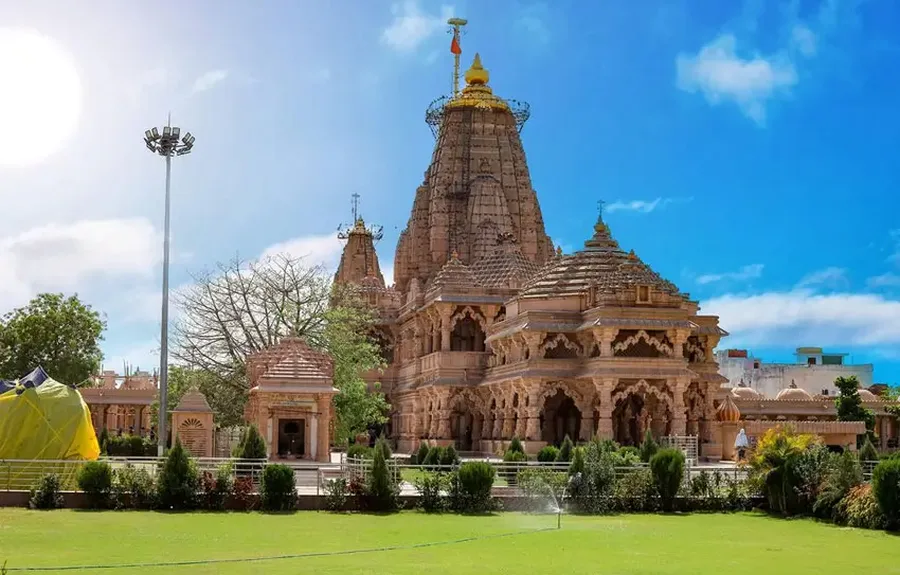
Beyond the famous desert cities lies a greener Rajasthan of lakes, wooded hills and small royal capitals that most visitors never reach. The...
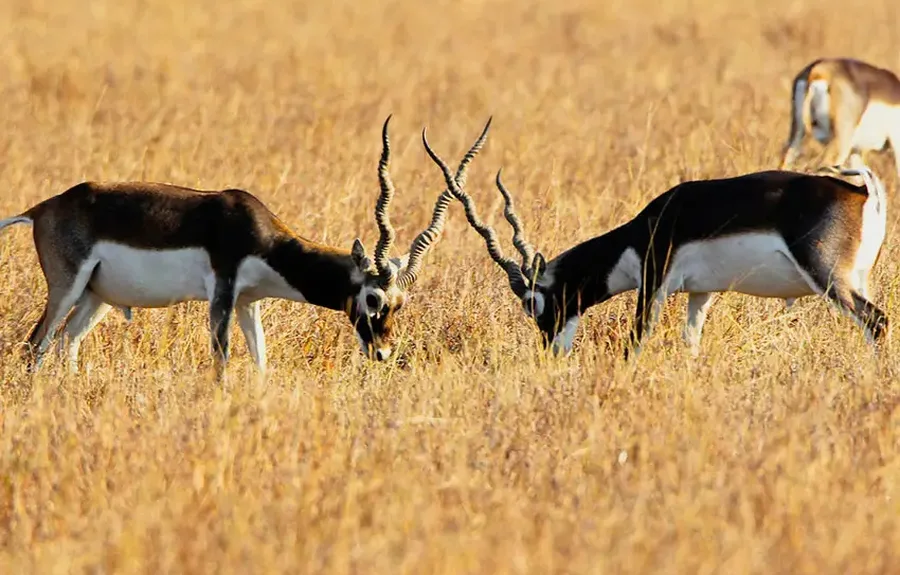
More than 500 bird species have been recorded in Rajasthan, from wintering cranes and pelicans on the wetlands of the east to sandgrouse,...
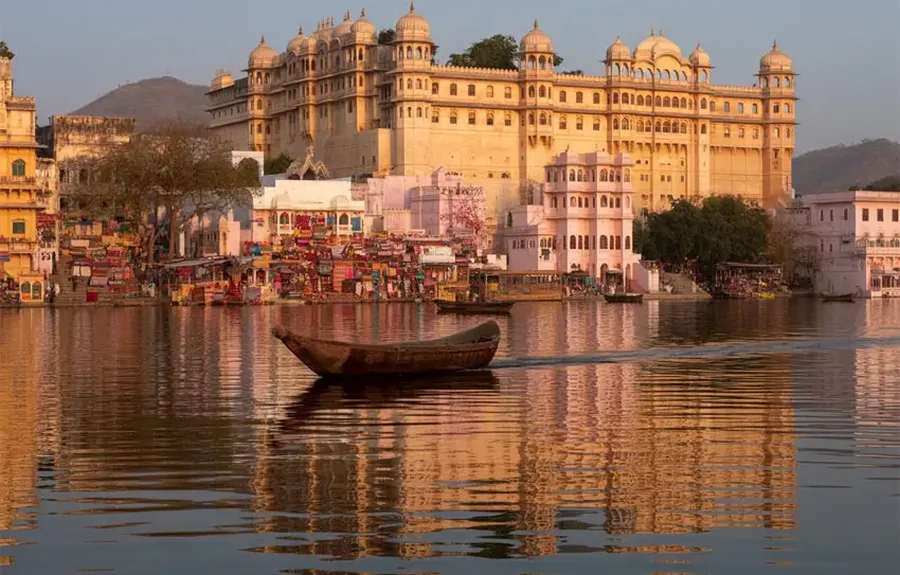
Rajasthan rewards patience, and the Rajasthan Tour for Senior Travelers is designed to let you enjoy it without strain. Over 11 nights and...
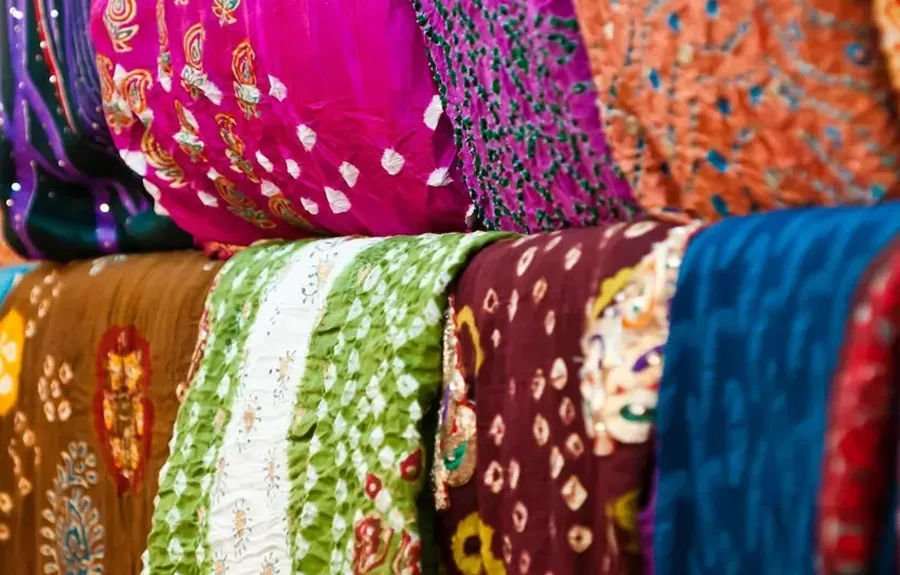
Almost every village in Rajasthan is known for a craft, and many of them are still practised by hand in family workshops, exactly...
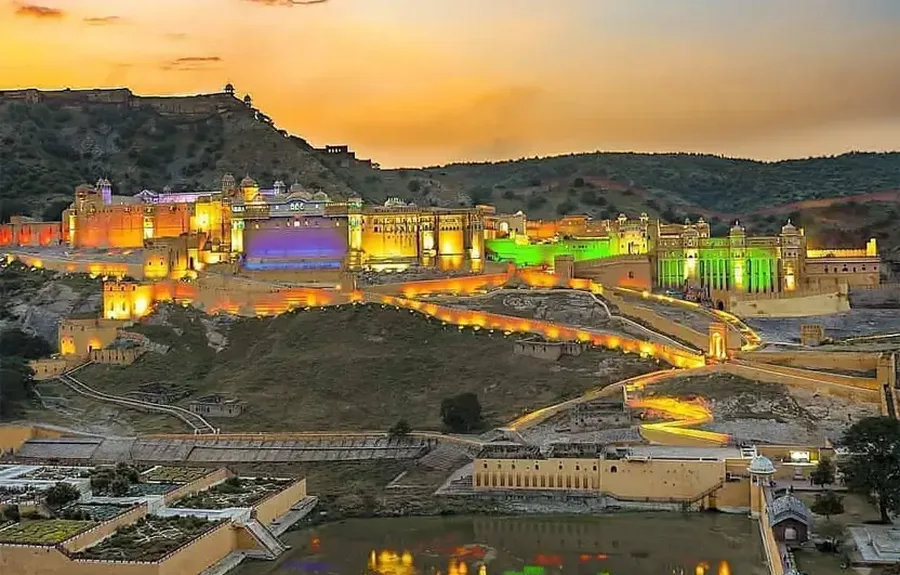
Most visitors see Rajasthan through a car window between one fort and the next. The Rajasthan Slow Travel Tour takes the opposite approach...
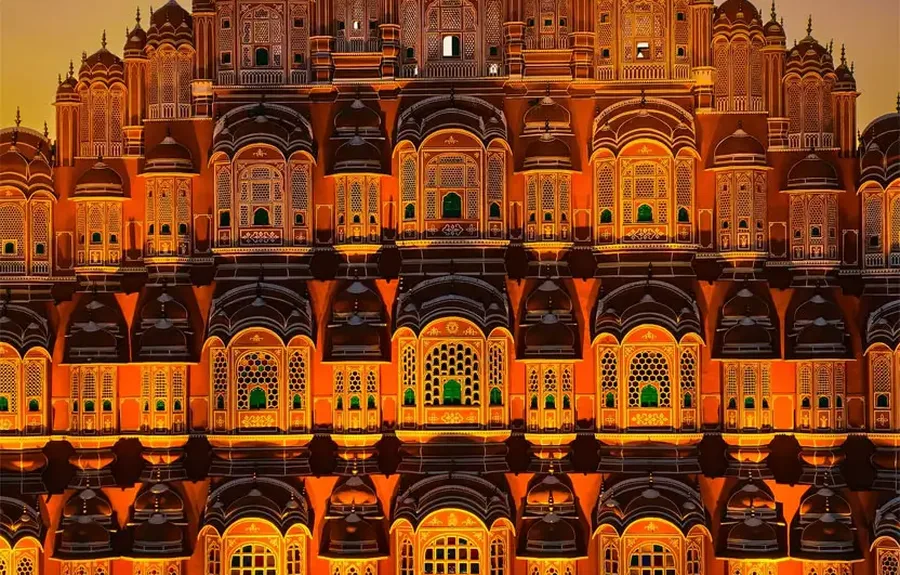
Lamps on every ghat, palaces outlined in light and fireworks reflected in still water make Diwali in Udaipur one of the loveliest festival...
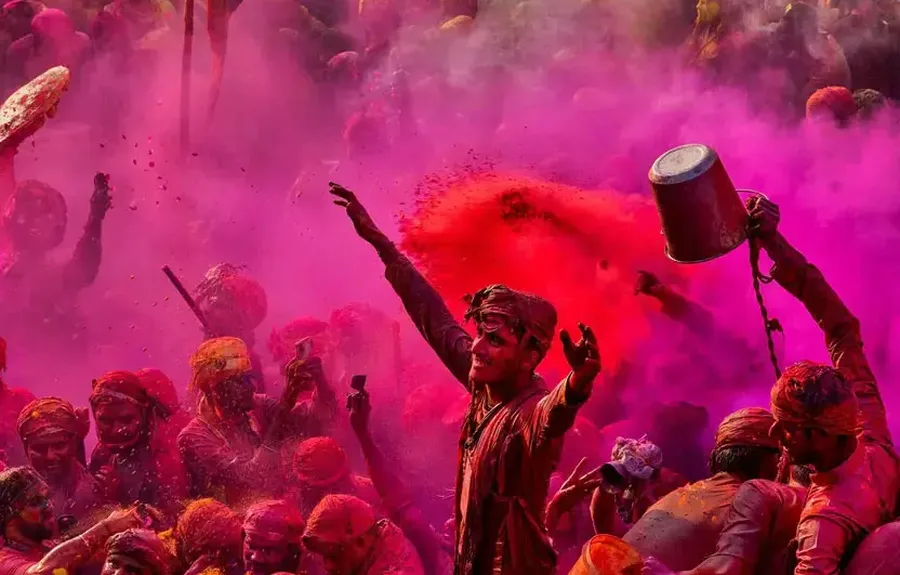
Holi arrives with the full moon of Phalgun, usually in March, when winter ends, the wheat turns gold and the whole of North...
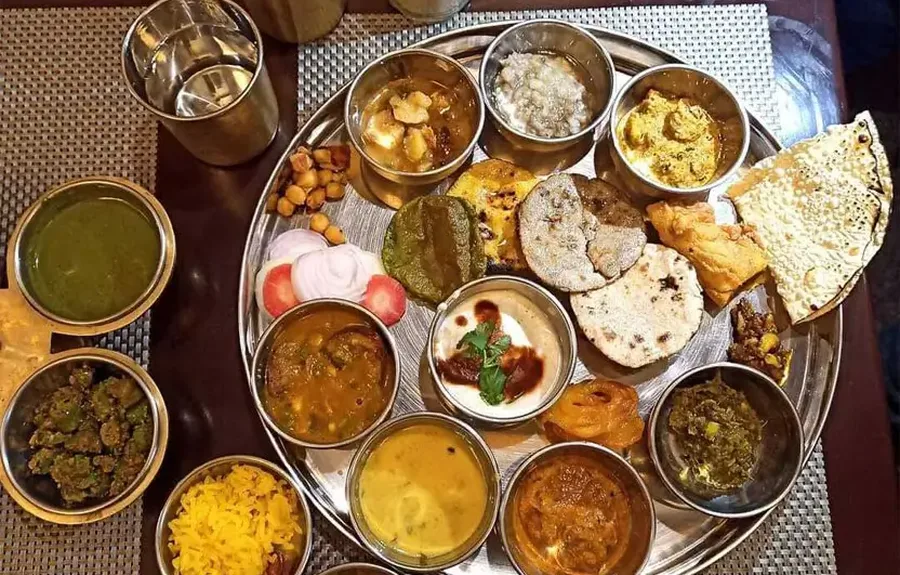
Desert cooking is a cuisine of clever survival. With little water and few fresh vegetables, Rajasthani cooks built a whole kitchen around dried...
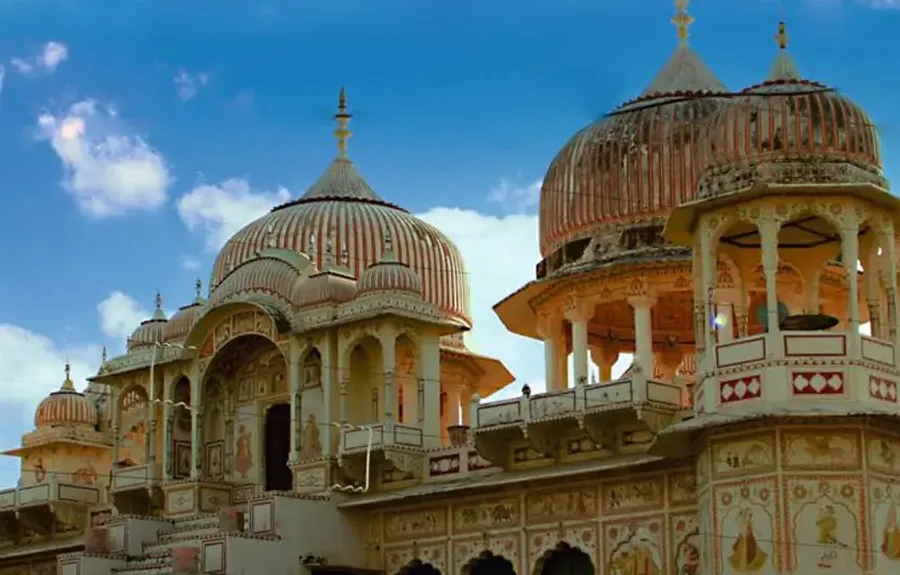
Turbans in saffron and magenta, indigo walls, golden sandstone and white marble reflected in still lakes: Rajasthan may be the most colourful state...
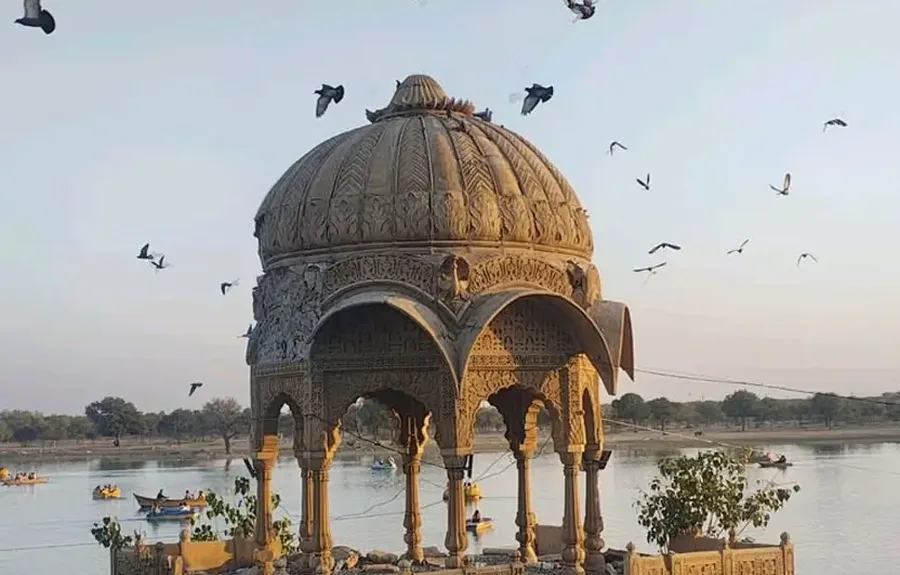
For a few days each autumn, around 50,000 camels, horses and cattle gather on the sands outside a small holy town, along with...