If you scroll through our reviews, one thing becomes obvious fairly quickly. A great many of them are written by people from Britain.
London, Manchester, Bristol, Cardiff, and small villages we have to look up on a map afterwards. Some found us through Tripadvisor. Some through a friend who came the year before. A surprising number through a documentary they half remember watching on a Sunday afternoon.
We have never advertised in the UK. We have never worked with agents there. So it is worth asking why, and after years of asking our guests directly, we think we understand most of the answer.
It has less to do with elephants than you might expect.
British guests turn up with questions written down. Not always politely, either, and we have grown to like that.
Are they tied up at night. How many hours a day are they with visitors. What happens to an elephant here when it gets old. Can I see where they sleep. Who looks after them when nobody is watching.
Nobody from anywhere else asks quite so many of these before booking. Our sense is that this comes from years of British newspapers and wildlife charities running stories about elephant tourism across Asia, most of them deserved. A generation of travellers has been taught to be suspicious, and they arrive suspicious.
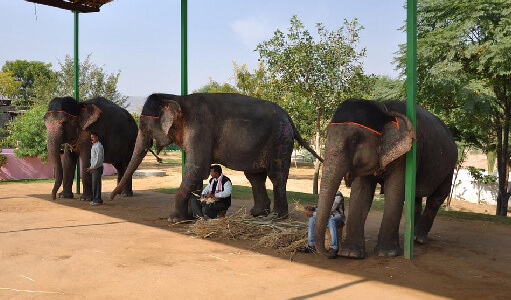
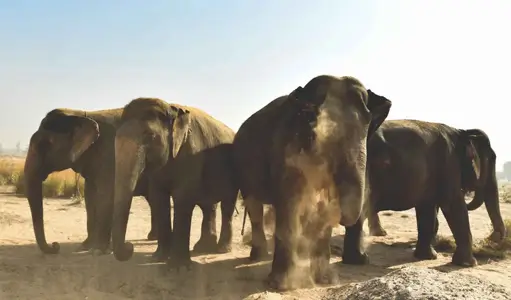
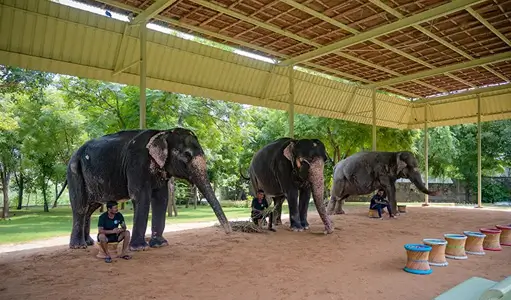
That suits us perfectly well. A guest who has already read about the problem understands immediately why we run an ethical elephant sanctuary in Jaipur the way we do. There is no riding here, there is nothing chained, and there is nothing performed for anybody.
We would rather be asked than not. Every question on that list has an answer, and our mahouts will give it to you standing next to the elephant in question. Several of them come from families who have worked with elephants for generations, and they explain this far better than any page on a website ever could.
The visitors who never ask are the ones we worry about, because they are the ones most likely to end up somewhere that would rather they did not.
Look at our booking calendar and the pattern is impossible to miss. British guests cluster between October and March.
Part of that is simply because this is when Rajasthan is comfortable. Jaipur in May is hard work for anybody, and we would not recommend it as a first visit.
But there is another half to it, and our guests explain it themselves without being asked. Their own outdoor season has closed. Campsites across England shut around the middle of October and do not reopen until spring. Walking gets wet and dark by four in the afternoon. The appetite for being outdoors does not disappear just because the weather has.
So they come here instead. February and November are our busiest months for UK visitors, and both are months when the alternative at home is a cold field and a wet tent.
One guest from Kent put it more bluntly than we would have. She said she had spent the whole summer sleeping in a field and had absolutely no intention of doing it again in January.
Meet elephants naturally, enjoy feeding and mud-bath experiences, and discover a responsible elephant experience designed for travellers from the UK.
This is the part we find most interesting.
Very few British guests compare us to a zoo. They compare us to camping.
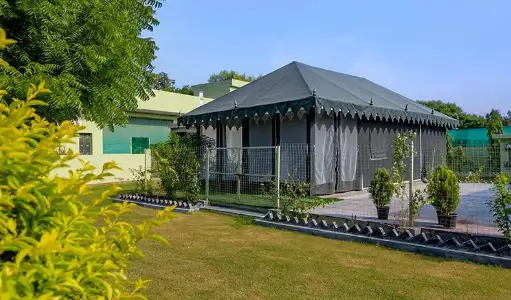
The comparison comes up most often around our night stay with elephants, where guests sleep in tents at the sanctuary rather than heading back to a hotel after a couple of hours. Sit with anybody at the fire that evening and within about twenty minutes they will start telling you about somewhere they camp at home.
It is almost always somewhere small. A field with a limited number of pitches, no electricity, a fire at each spot, and a rule against cars. One couple described a place doing bell tent glamping in Kent with thirty two pitches spread across eight acres, no wifi and no sockets anywhere, where you wheel your bags in on a barrow because vehicles are not allowed past the gate. They talked about it for a good half hour, and by the end of it we understood exactly why they had booked with us.
The equipment is different. Our tents sit in Rajasthan and theirs sit in a chalk meadow in southern England. But the thing being described is identical. Canvas, a fire, no screen, and animals carrying on with their evening nearby without any particular interest in you.
That is the whole point of the night stay, and it is a genuinely difficult thing to put in a brochure. During the day there is a shape to the visit. In the evening there is not. The elephants eat, they move about, they make noises we stopped noticing years ago and guests have not. Nothing has been arranged. That is the experience.
For a lot of visitors, the no riding policy is a pleasant detail they notice on the way in. For British guests it is frequently the entire reason they booked.
Several have told us they changed their plans in Jaipur once they had read properly about what is involved elsewhere. Others arrive having already made that decision years ago and simply want somewhere that matches it.
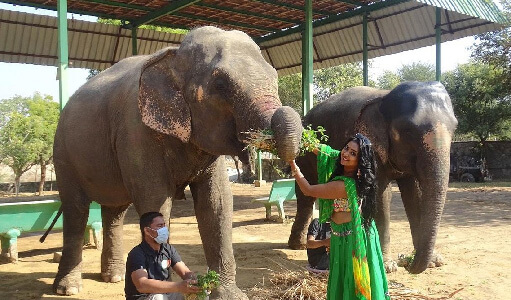
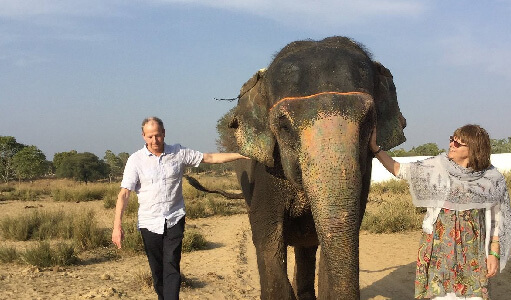
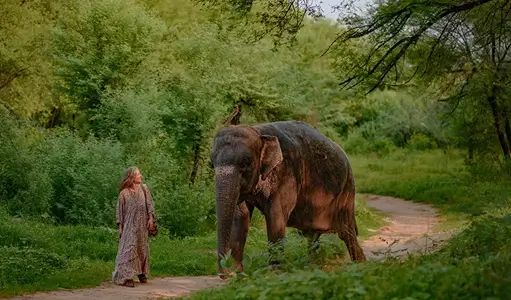
We do not think being dramatic about this helps anybody, so we will simply describe what we do instead. Guests walk with the elephants at their pace. They feed them sugarcane and seasonal fruit by hand. They watch them take a mud bath, which the elephants do because they want to rather than because it is on a timetable. Each guest spends the visit with one elephant rather than moving down a line of them.
There is no painting, no tricks, and no photograph of you sitting on top of anything. A no riding elephant experience makes for a quieter afternoon than the alternative. It is also the only version of this we are willing to run.
Another question that comes up far more often from UK guests than from anyone else. What do the elephants actually do when there are no visitors here.
It is a fair question and the answer is fairly ordinary. They eat, at considerable length. They stand in shade. They walk. They spend a great deal of time doing nothing much at all, which is broadly what elephants do when left to it.
Guests on the overnight stay are the only ones who really see this, because they are here before the day visits begin and after they have finished. That gap is where the sanctuary is most itself. Nobody is arriving, nothing is scheduled, and the animals are simply getting on with their morning.
Almost every guest who has done the night stay tells us afterwards that this was the part they remember. Not the feeding and not the mud bath, but standing in a field at seven in the morning with nothing whatsoever happening.
British visitors tend to be careful bookers, which we appreciate rather more than they probably realise.
They confirm dates in writing. They ask who exactly they are speaking to. They tend to arrive with the whole WhatsApp conversation still on their phone.
This matters here because agents, guides and drivers in Jaipur are paid commission to take visitors to other elephant operations under our name. It happens regularly and it is the single biggest complaint we deal with. Somebody books what they believe is Elefantastic, gets driven somewhere else entirely, and has an afternoon that bears no resemblance at all to what they read about.
So we say it plainly on every page. Bookings come directly to Rahul, by WhatsApp or by email, and nowhere else. We do not accept walk ins under any circumstances and we do not work through middlemen. If a driver tells you he can take you to us without a booking, he cannot.
Guests who check twice never run into this. Guests who leave the arrangement to somebody else at their hotel occasionally do.
Looking for a meaningful elephant experience in India? Spend time with elephants without riding, performances or chains at our Jaipur sanctuary.
One practical thing worth mentioning, because it surprises people every single winter.
Jaipur in December and January is warm in the afternoon and genuinely cold first thing. Guests arrive expecting a hot country, pack accordingly, and then find themselves standing in a field at half past six in the morning wishing they had brought a jacket.
If you are doing the overnight stay between November and February, bring layers. A fleece, something warm for your head, and socks you can sleep in. It is much the same advice you would give somebody camping in Britain in October, which our guests usually find quite funny once they have stopped shivering.
By ten in the morning you will have taken all of it off again. That is simply how the season works here.
Most people find us because of the elephants. Very few come to India only for that.
So a good deal of our time goes on helping guests with everything around it. Where to go after Jaipur. Whether three nights in Udaipur is too many. Whether the drive to Jodhpur is worth doing. How much time Agra actually needs, which is usually less than people assume.
We plan full India tour packages now for exactly that reason, because guests kept asking and because sending somebody off with a poor driver can undo an otherwise good week. The Golden Triangle is the most requested route by some distance, though the ones we most enjoy putting together are the longer Rajasthan circuits where there is room to slow down and stay two nights somewhere rather than one.
British travellers, in our experience, plan further ahead than most. Four to six months is common and nobody finds that unusual. They also change their minds less once they arrive, which makes them straightforward to look after and means we can hold a tent for them without worrying about it.
Families make up a decent share of our UK bookings, usually with children between about six and fourteen.
Parents often arrive nervous. They have booked something involving a very large animal and they are not entirely sure how it will go. What tends to happen is that the children settle within about ten minutes, mostly because there is nothing here designed to excite them. No queue, no ride, no photographer.
What they get instead is time. A child with a bucket of fruit and one elephant to give it to will happily stay there for an hour. Several parents have told us it was the only stop on their trip where nobody asked for a phone.
The mud bath is invariably the high point. It is also the messiest part of the day, which is why we keep suggesting old clothes and closed shoes and why so few people take that advice seriously until afterwards.
The reviews have a pattern to them, and it is not the pattern we expected when we started.
Almost nobody leads with the elephants being impressive. They lead with how ordinary it felt. Standing in a field in the morning while an elephant eats. Watching one decide, at some length, exactly which patch of mud it prefers. Being comprehensively ignored for a while.
A guest from Wales wrote that it was the only part of her trip where nothing had been staged for a camera. That sentence has stayed with us, because it describes what we are trying to do rather better than anything we have written ourselves.
It is also, we suspect, why the comparison with a small British campsite keeps coming up. Both are places where the animals were not arranged for you, and where the appeal lies entirely in what happens when nobody is performing.
A few practical notes, since these come up in almost every message we receive.
And if you camp at home, do mention it when you arrive. You will find the evening makes rather more sense to you than it does to most visitors, and you will almost certainly end up in a long conversation with one of us about tents.
The answer depends on the operator's programme and transfer. Confirm the actual activity time, briefing, waiting, pickup and return. Avoid packing a long elephant session between multiple forts in hot weather.
Hathi Gaon is a purpose-built settlement near Amber for mahout families and elephants. Its original design combined housing, elephant shelters, water bodies, planting and community space.
It links elephant housing and care with mahout livelihoods, water management and Jaipur tourism. It is also a useful place to examine the difference between welfare-focused design and current day-to-day practice.
It is in the Amber area near Jaipur. Ask the operator for the current map pin and correct entrance because pickup points and routes may differ.
The site was designed with shelters, water and organized infrastructure, and official guidance sets expectations for captive-elephant care. Current welfare cannot be guaranteed from the design alone. Ask for recent veterinary oversight, records and observable daily practices.
Mahouts handle much of the daily care, supported by owners, authorities and veterinary professionals according to the arrangement for each elephant. Ask a specific operator who is responsible and how veterinary decisions are recorded.
It can be educational when the visit explains architecture, elephant biology, daily care, mahout livelihoods and welfare standards. A photo-focused interaction with little explanation should not be marketed as education without further evidence.
The project and many operators use welfare and responsible-tourism language. Visitors should judge each experience by current practices, elephant choice, rest, handling, veterinary oversight and transparency rather than by the label alone.
A qualified guide or caretaker can explain observed behaviour and individual history. Avoid claims that interpret every movement as happiness or consent, especially during a paid interaction.
It is widely described as a pioneering purpose-built settlement for elephants and mahouts. The word first is difficult to verify consistently across different definitions, so the safer description is one of India's best-known planned elephant and mahout housing projects.
Visitor spending can support food, veterinary care, mahout livelihoods and education when funding is transparent. Ask how revenue is used and whether welfare outcomes are independently checked.
Activities vary by operator and may change. This guide recommends avoiding riding and choosing observation or education that does not require the elephant to carry tourists or perform.
Not automatically. Ask whether the elephant chooses to enter and leave, whether visitors scrub or climb on the animal, how many sessions occur and how refusal is respected. Observation of natural bathing is a lower-contact option.
Entry, private activities and transport may be priced separately and can change. Request a written total for the exact date and do not rely on an old blog price.
No elephant interaction is risk-free. Children need continuous adult supervision, clear barriers and an age-appropriate safety briefing. They should never approach, feed or touch an elephant without authorized guidance.
Use closed comfortable footwear and clothing suited to the weather. Carry sun protection and water. If a booked activity involves mud or water, ask about changing facilities before arrival.
Rules depend on the area and operator. Avoid flash, drones, close selfies and forced poses. Obtain consent before photographing mahouts, residents or children.
Hathi Gaon deserves a guide that covers its planning history and its present responsibilities. The settlement's water bodies, shelters, housing clusters and landscape repair provide useful context, but ethical tourism must be judged through current evidence and daily practice.
Book only after confirming the exact operator, activities, welfare safeguards, total price, access and cancellation terms. During the visit, prioritize observation, questions and resident privacy. Declining riding, performance or unwanted direct contact is a valid part of responsible travel.