The Khajuraho Temples are among India's most extraordinary architectural achievements, attracting travelers, historians, photographers, architects, and art enthusiasts from around the world. Located in the central Indian state of Madhya Pradesh, this UNESCO World Heritage Site is celebrated for its intricate stone carvings, remarkable temple architecture, and centuries of fascinating history. While many people first hear about Khajuraho because of its famous sculptures, visitors soon realize that the site represents far more than a collection of artistic carvings. It is a masterpiece of engineering, religious devotion, cultural expression, and medieval craftsmanship that continues to inspire scholars and travelers alike.@#$%^&*(
Unlike many historical monuments that have gradually lost their original appearance through repeated reconstruction, the temples at Khajuraho still display an extraordinary level of architectural detail. Every wall, pillar, entrance, ceiling, and tower reflects the skill of artisans who transformed sandstone into remarkably detailed works of art. The sculptures portray everyday life, music, dance, spirituality, mythology, royal ceremonies, celestial beings, animals, and symbolic representations that together illustrate the richness of Indian civilization during the Chandela dynasty.
International visitors often arrive expecting to see only the well-known erotic sculptures frequently mentioned in travel books and documentaries. Although these carvings are certainly part of Khajuraho's identity, they actually represent only a small percentage of the thousands of sculptures decorating the temple complex. The overwhelming majority of carvings depict religious beliefs, cultural traditions, musicians, warriors, dancers, families, gods, goddesses, floral designs, and scenes from daily life. Understanding this broader artistic context allows visitors to appreciate the temples as complete works of cultural heritage rather than focusing on a single aspect of their decoration.
The peaceful surroundings also contribute significantly to the experience. Unlike crowded urban monuments surrounded by heavy traffic, the Khajuraho temple complexes are set within beautifully maintained gardens that provide a calm atmosphere for exploration. Visitors can comfortably walk between temples while appreciating their towering spires from different angles, making the site especially rewarding for photography enthusiasts and architecture lovers.
The Western Group of Temples attracts the largest number of visitors because it contains some of the finest preserved monuments, including the magnificent Kandariya Mahadeva Temple. The Eastern and Southern Groups provide a quieter experience while showcasing different architectural styles and religious influences. Together, these complexes offer valuable insight into the artistic and spiritual diversity that flourished in central India many centuries ago.
Beyond the temples themselves, Khajuraho serves as an excellent destination for travelers interested in India's historical heritage. Museums, cultural performances, archaeological sites, nearby nature reserves, and regional handicrafts provide additional opportunities to understand the area's rich cultural landscape. Many visitors combine Khajuraho with destinations such as Varanasi, Orchha, Gwalior, Agra, or the Golden Triangle itinerary to create a broader journey through India's architectural heritage.
Understanding the historical background, symbolism, architectural techniques, and practical travel information before visiting allows travelers to appreciate Khajuraho beyond its reputation. Every sculpture, decorative panel, and carefully carved tower contributes to a remarkable story that has survived for centuries despite changing kingdoms, political upheavals, and the passage of time.
Step beyond the famous sculptures and experience the history, architecture and artistry of Khajuraho with a thoughtfully planned private journey through India’s remarkable heritage.
The history of the Khajuraho Temples begins during the rule of the Chandela dynasty, one of the most influential royal families in central India during the medieval period. Between the ninth and twelfth centuries, the Chandelas transformed Khajuraho into an important religious and cultural center by constructing an impressive collection of Hindu and Jain temples that reflected both political strength and artistic excellence.
Historical records suggest that approximately eighty-five temples originally stood across the region. Today, around twenty-five temples remain preserved, representing one of the finest surviving examples of medieval Indian architecture. Although time, changing political circumstances, and natural weathering caused many structures to disappear, the surviving monuments continue to demonstrate the remarkable vision and engineering capabilities of their creators.
The temples were not built simultaneously. Instead, construction continued over several generations of Chandela rulers, each contributing new monuments dedicated to different deities and religious traditions. This gradual development explains the subtle differences in architectural style, decorative themes, and sculptural techniques visible across the various temple complexes.
Religion played a central role in the creation of Khajuraho. Most temples were dedicated to Hindu gods such as Shiva, Vishnu, and Devi, while others served Jain communities. Rather than representing religious competition, the coexistence of multiple traditions illustrates the cultural diversity that characterized the region during the Chandela period. This harmonious architectural landscape continues to attract scholars studying medieval India's social and religious history.
The location of Khajuraho also contributed to its preservation. Following the decline of the Chandela dynasty, political centers gradually shifted elsewhere, allowing the temples to remain relatively isolated from large-scale urban development. Dense forests slowly surrounded the monuments, protecting many structures from extensive human interference for centuries.
During the nineteenth century, British surveyors documented the temples after local communities guided them to the forgotten monuments hidden among vegetation. Their reports introduced Khajuraho to the wider international community, eventually leading to archaeological conservation efforts that continue today. Restoration programs have focused on preserving original stonework while maintaining the authenticity of these extraordinary structures.
The temples were later recognized as a UNESCO World Heritage Site, acknowledging their exceptional artistic, historical, and cultural significance. This international recognition has helped promote conservation initiatives while encouraging responsible tourism that supports preservation for future generations.
Today, the Khajuraho Temples remain among India's most important historical landmarks, attracting visitors interested in architecture, archaeology, religion, history, photography, and cultural heritage. Their remarkable survival offers an extraordinary opportunity to experience medieval craftsmanship almost exactly as it appeared centuries ago.
The architecture of the Khajuraho Temples is regarded as one of the finest achievements of medieval Indian craftsmanship. Every temple reflects a remarkable balance between engineering precision, artistic creativity, and spiritual symbolism. Although each structure has its own distinctive features, they collectively follow the principles of the Nagara style of temple architecture, which became prominent across northern India.
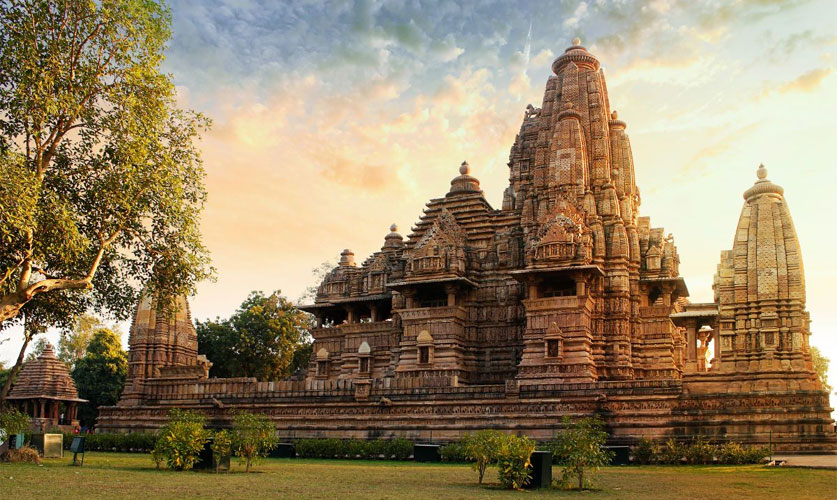
One of the first features visitors notice is the impressive vertical design. Instead of appearing wide and heavy, the temples rise gracefully toward the sky through a series of beautifully carved towers known as shikharas. The tallest central tower represents the sacred mountain believed to connect the earthly world with the divine. Smaller surrounding towers gradually increase in height as they approach the main shrine, creating a visually harmonious composition that appears almost like a mountain range carved entirely from stone.
The builders used fine-grained sandstone that allowed artisans to produce extraordinary detail. Even after centuries of exposure to changing weather conditions, many carvings remain remarkably sharp and expressive. Unlike monuments assembled with large quantities of mortar, many sections of the temples were constructed using carefully interlocking stone blocks, demonstrating the advanced engineering knowledge of the Chandela craftsmen.
Every part of the temple exterior contributes to the overall artistic narrative. Walls are divided into horizontal bands filled with sculptures portraying musicians, dancers, warriors, animals, mythical creatures, celestial beings, and scenes from everyday life. Decorative floral patterns and geometric motifs connect these figures into a continuous visual composition, leaving very little empty stone surface.
The interior architecture is equally impressive. Large entrance halls supported by elaborately carved pillars lead visitors toward the sacred sanctum where the principal deity was worshipped. High ceilings decorated with intricate stone patterns create a sense of openness despite the enclosed space. Natural light entering through carefully positioned openings enhances the atmosphere without overwhelming the detailed carvings.
Among all the temples, the Kandariya Mahadeva Temple is considered the masterpiece of Khajuraho's architecture. Standing approximately 31 metres (102 feet) high, it contains hundreds of sculptures arranged with remarkable symmetry. Its towering silhouette dominates the Western Group and remains one of the finest examples of medieval temple construction anywhere in India.
Other significant structures include the Lakshmana Temple, dedicated to Lord Vishnu, the Vishwanath Temple, the Chitragupta Temple, and the beautifully preserved Parsvanatha Temple in the Eastern Group. Each reflects subtle architectural variations while maintaining the overall aesthetic principles that define the Khajuraho complex.
Walking through these monuments reveals that the temples were designed not merely as places of worship but as complete works of architectural art. Every sculpture, pillar, staircase, and tower contributes to a carefully planned visual experience that continues to impress architects and historians from around the world.
The sculptures of Khajuraho have attracted worldwide attention for generations. However, one of the biggest misconceptions among first-time visitors is that the temples consist mainly of erotic carvings. In reality, these famous sculptures represent only a small percentage of the thousands of carvings covering the temple walls.
Most sculptures portray aspects of everyday medieval life. Visitors can observe beautifully carved musicians playing traditional instruments, dancers performing graceful movements, royal processions, hunting scenes, teachers instructing students, craftsmen at work, soldiers preparing for battle, and families engaged in ordinary activities. These images provide valuable insight into the social and cultural life of central India during the Chandela period.
Religious symbolism is equally prominent. Numerous carvings depict Lord Shiva, Lord Vishnu, Devi, Ganesha, celestial guardians, mythical creatures, divine attendants, and scenes drawn from Hindu mythology. Jain temples within the complex contain equally remarkable representations of Jain Tirthankaras, demonstrating the religious diversity that flourished in the region.
The famous erotic sculptures are generally located on the outer walls rather than inside the sanctuaries. Historians have proposed several interpretations regarding their symbolic meaning. Some scholars believe they celebrate the balance between spiritual and worldly life, while others suggest they represent prosperity, fertility, human relationships, or philosophical concepts associated with medieval Indian traditions. There is no single universally accepted explanation, making these sculptures an ongoing subject of academic discussion.
Importantly, these carvings were never intended as isolated works of art. They form part of a much larger decorative program illustrating the complete spectrum of human existence—from birth and family life to music, devotion, celebration, spirituality, and ultimately the search for enlightenment.
The extraordinary realism of the sculptures continues to fascinate visitors. Facial expressions, flowing garments, elaborate jewelry, hairstyles, body posture, and even subtle emotional gestures were carved with astonishing precision. Many figures appear remarkably lifelike despite having been created centuries ago using simple hand tools.
Photography enthusiasts often spend hours examining the intricate details that may easily be overlooked during a quick visit. Every section of the temples reveals new artistic elements, making repeated observation highly rewarding.
Rather than viewing Khajuraho solely through the lens of its most famous carvings, visitors gain a far richer understanding by appreciating the complete artistic vision represented across the entire temple complex.
Explore the temples through their architecture, symbolism and centuries-old craftsmanship with a private India tour designed for travelers who appreciate culture in depth.
A well-organized visit allows travelers to appreciate the temples without feeling rushed. The temple complexes are maintained by the Archaeological Survey of India (ASI) and remain among the country's best-preserved historical monuments.
The Western Group of Temples, which contains the majority of the famous monuments, is generally open daily from approximately 8:00 AM until 6:00 PM. Since operating hours may occasionally change because of official events or maintenance work, visitors should confirm timings before arrival.
The Western Group requires an entry ticket, while some temples in the Eastern and Southern Groups can be visited without additional charges. For international visitors, the current ticket price for the Western Group is approximately ₹600 per person, while Indian citizens pay a lower domestic rate. Children below specified age limits may receive complimentary admission according to ASI regulations.
Many travelers choose to arrive early in the morning when temperatures are comfortable, lighting conditions are ideal for photography, and visitor numbers remain relatively low. Late afternoon also provides beautiful natural light that enhances the warm color of the sandstone architecture.
Photography for personal use is generally permitted throughout most areas of the temple complex. Professional filming, commercial photography, drones, or special equipment may require separate permissions from the relevant authorities. Visitors should always respect posted regulations and avoid touching delicate carvings while taking photographs.
Comfortable walking shoes are recommended because exploring all three temple groups involves considerable walking across landscaped pathways. Carrying drinking water, sunscreen, sunglasses, and a hat is especially advisable during warmer months when temperatures in central India can become quite high.
Local guides are available near the entrance, although visitors should verify official authorization before hiring anyone. Licensed guides provide valuable historical context that enhances appreciation of the temples' architecture, symbolism, and cultural significance.
Many visitors also attend the evening Sound and Light Show, which presents the history of the Chandela dynasty and the construction of Khajuraho through narration, lighting effects, and music. The program offers an engaging introduction to the historical background before or after exploring the monuments themselves.
Khajuraho is well connected by Khajuraho Airport, railway services through nearby stations, and road networks linking the region with destinations such as Orchha, Jhansi, Gwalior, Varanasi, and Agra. Travelers following broader heritage routes often combine Khajuraho with these historic cities to experience different chapters of India's architectural history.
The temples are internationally renowned for their exceptional medieval architecture, intricate sandstone carvings, and UNESCO World Heritage status.
The temples are located in the Chhatarpur district of Madhya Pradesh in central India.
The temples were constructed by the Chandela dynasty between the ninth and twelfth centuries.
Around 25 temples survive from the original complex of approximately 85 temples.
The Western Group of Temples is generally open daily from 8:00 AM to 6:00 PM.
International visitors currently pay approximately ₹600 for entry to the Western Group of Temples.
No. Erotic sculptures represent only a small portion of the thousands of carvings. Most depict religion, music, dance, mythology, daily life, and cultural traditions.
Most travelers spend a full day exploring all three temple groups, while history enthusiasts often stay for two days.
Yes. Personal photography is generally permitted, although drones and commercial filming may require special permission.
The cooler months from October to March provide the most comfortable weather for sightseeing and photography.