Searching for a genuine elephant sanctuary in India can be more complicated than it first appears. A website may use words such as sanctuary, rescue, conservation, ethical or welfare-friendly, but the label alone does not explain how elephants actually spend their day. For a traveller trying to make a responsible choice, the important information is found in the facility's practices rather than its marketing vocabulary.
The most useful questions are practical. Does the facility offer elephant rides? Are elephants required to perform tricks or repeated poses? How much control do visitors have over the animal? Are interactions designed around the elephant's routine or around a continuous flow of tourists? How are elephants restrained, housed and cared for when visitors are not present? Does the business explain where its elephants came from and what long-term care looks like?
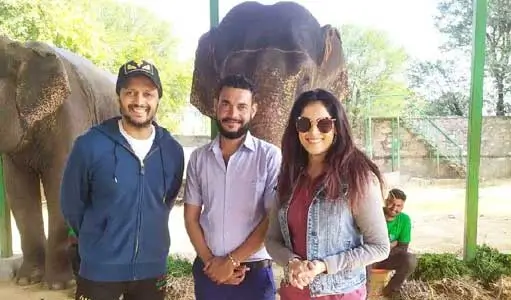
Travellers should also recognise that elephant welfare is a complex subject. Captive elephants cannot simply be assessed through a few attractive photographs. An elephant standing calmly beside a smiling visitor tells very little about what happens during the rest of the day. A meaningful assessment requires looking at management practices, physical condition, behaviour, visitor activities and the facility's willingness to answer difficult questions.
For visitors searching for an ethical elephant experience in India, especially around Jaipur, taking twenty minutes to investigate before paying can prevent supporting an attraction that uses welfare language while continuing entertainment practices that the traveller personally wants to avoid.
The quickest way to narrow down an elephant facility is to examine exactly what tourists are being invited to do. If a business describes itself as an ethical sanctuary but prominently sells elephant rides, performances, tricks or entertainment routines, the visitor should examine that contradiction carefully before booking.
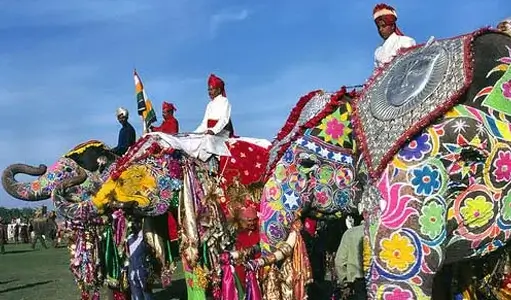
Riding is not simply a question of whether a tourist sits on an elephant for ten minutes. A responsible evaluation should consider the wider system required to make a very large, intelligent animal reliably carry unfamiliar visitors according to a commercial timetable. Travellers interested in animal welfare increasingly look for experiences that do not require elephants to function as transportation or perform for an audience.
Performances deserve the same scrutiny. Activities in which elephants are expected to repeat tricks, dance-like movements or other entertainment behaviours on command are fundamentally different from quietly observing natural or routine behaviours.
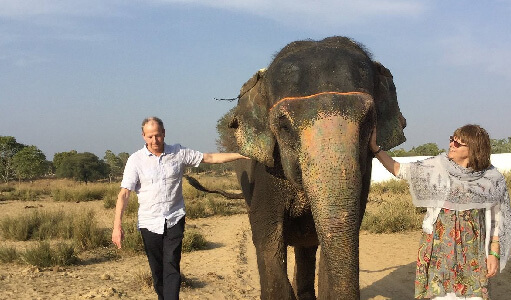
Photography can create another grey area. There is a difference between taking photographs while spending time near an elephant and requiring the elephant to perform repeated poses for a continuous stream of visitors.
A genuine welfare-focused facility should be able to explain why each visitor activity exists and whether participation is optional for the elephant.
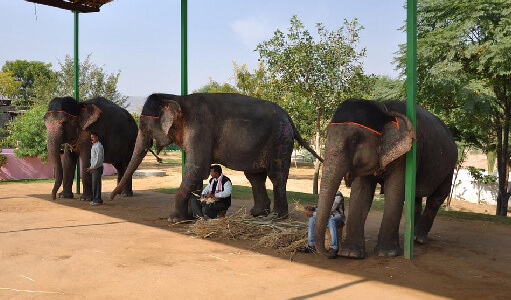
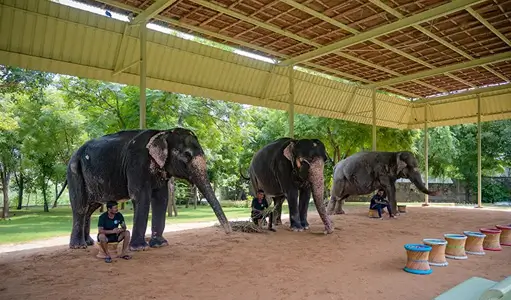
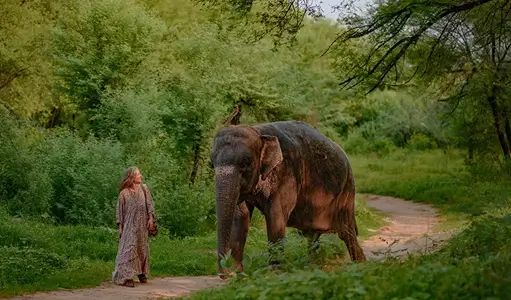
Elefantastic in Jaipur follows a no-riding, no-performance approach, focusing instead on appropriate time beside elephants. For travellers comparing facilities around Jaipur, this distinction is an important starting point.
However, visitors should not stop their research after seeing “no rides” written on a website. That is one useful criterion, not complete proof of high welfare. The rest of the elephant's daily life matters just as much.
Discover responsible elephant experiences that prioritise animal welfare, natural behaviour, proper care, and ethical tourism practices.
The word sanctuary can create an immediate emotional impression of rescued animals living peacefully with minimal human interference. Travellers should avoid assuming that every business using the word operates according to the same model.
Ask what the elephants actually do during a normal twenty-four-hour period.
How much of the day involves visitors? Do elephants have meaningful periods without tourist interaction? Are they able to rest, feed and move without being continuously surrounded by people?
Elephants spend a large portion of their natural daily activity moving and feeding. A facility that keeps an animal in one small visitor area for repeated tourist sessions should therefore prompt further questions.
Ask about overnight arrangements as well. The public experience may last only two hours, but welfare continues after tourists leave.
Where do the elephants spend the night? What type of shelter is available? How are they protected during extreme heat, rain or cooler conditions? How much space do they have?
A transparent operator should be able to discuss ordinary care without turning every answer into promotional language.
Travellers should also pay attention to how the daily schedule changes according to the elephant rather than the customer. Extremely hot weather, health concerns or an animal's behaviour may require an activity to be shortened or changed.
A business that promises every interaction in exactly the same way regardless of conditions may be treating the elephant experience too much like a fixed amusement product.
Enjoy a personalised India journey with carefully selected wildlife experiences, knowledgeable local guides, and private chauffeur-driven travel.
Chains are one of the most emotionally charged issues in captive elephant tourism. Visitors may reasonably prefer facilities that minimise restraint, but assessing the subject through a single photograph can be misleading.
The important questions are when restraint is used, why it is used, for how long and what alternatives exist.
An image showing an elephant wearing or standing near a chain does not by itself explain the entire management system. Equally, a carefully staged visitor photograph showing no visible restraint does not prove that chains are never used outside tourist hours.
Travellers should therefore ask directly.
Is the elephant chained during visitor sessions? Is restraint used overnight? Is it used for veterinary procedures, transport or safety management? How long can an elephant remain restrained? Does the facility have secure spaces where elephants can move without being tethered?
The quality of the answer matters. A responsible operator should be willing to explain management practices rather than dismissing the question or becoming defensive.
Visitors should also understand that captive elephant management involves real safety considerations. Elephants are enormously powerful animals, and staff must protect both the animals and humans around them.
This does not mean every restraint practice is automatically justified. It means welfare assessment should examine the purpose, duration, method and frequency of restraint rather than relying entirely on whether a chain appears in one social-media photograph.
Transparency is more valuable than a perfect-looking image.
Travellers do not need to be veterinarians to notice obvious welfare concerns, but they should also avoid diagnosing an elephant from a few minutes of observation.
Look at the overall physical condition.
Visible untreated wounds, significant skin injuries, obvious foot problems or severe body-condition concerns deserve questions. Elephant feet are particularly important because these animals carry enormous body weight.
Repeated abnormal behaviours can also deserve attention. Continuous swaying, rocking or repetitive head movements may be associated with captive management conditions, although visitors should avoid drawing a complete diagnosis from one brief observation.
An elephant may also move repeatedly for reasons that a visitor does not understand. This is why asking knowledgeable staff is important.
Notice how the elephant responds to handlers. Does the interaction appear calm and predictable, or does the animal seem repeatedly pressured into visitor activities?
Also observe whether elephants are allowed to disengage.
A facility can claim that interactions are voluntary, but visitors should consider what happens when an elephant walks away. Is the animal allowed to remain away, or is it immediately directed back toward tourists?
This is a particularly useful question because genuine choice becomes visible when an animal chooses not to participate.
Visitors should remember that a calm-looking elephant is not automatically a happy elephant, just as an active elephant is not automatically distressed. Behaviour needs context.
A strong ethical elephant sanctuary should be willing to discuss individual personalities, preferences, health and daily routines rather than presenting every elephant as an identical tourist attraction.
A facility's explanation of each elephant's history can reveal a great deal about its approach.
Ask where the elephants came from and how they arrived at the facility.
Were they transferred from another captive setting? Did they previously work in tourism or another industry? How long have they been under the current care arrangement?
The term rescued elephant should not be accepted without any explanation. Rescue can mean different things in different contexts, and travellers should be cautious when the word is used primarily as an emotional marketing tool.
A transparent facility should be able to provide a coherent account of its animals' backgrounds while respecting any legitimate limitations around documentation or previous ownership.
Travellers should also be cautious about facilities where new elephants appear regularly without a clear explanation. If a business continuously acquires animals while presenting every acquisition as a rescue, visitors may reasonably ask how those transfers occur.
Another useful question concerns breeding.
Does the facility intentionally breed elephants? If so, what is the stated purpose, and what will happen to calves throughout their lives?
A true long-term welfare commitment must consider decades rather than one tourist season. Elephants are long-lived animals, so taking responsibility for one creates a substantial obligation.
The relationship between an elephant and its mahout or long-term caregiver is an important part of captive elephant management in India. Travellers should avoid reducing the subject to a simplistic assumption that every handler is either a perfect guardian or an abusive controller.
Elephant care requires experience, knowledge of individual behaviour and the ability to manage an extremely large animal safely.
Visitors should observe how caregivers interact with elephants during ordinary moments. Calm communication and familiarity can indicate a long-established relationship, although a short tourist visit cannot reveal everything.
Ask whether elephants generally have consistent caregivers or whether unfamiliar handlers rotate constantly.
Consistency can matter because an experienced caregiver learns an individual elephant's habits, physical condition and behavioural changes.
Travellers can also ask how staff are trained and how veterinary concerns are reported.
The welfare of the human caregivers matters as well. A sanctuary model that depends on poorly supported staff can struggle to provide stable long-term animal care.
Responsible tourism should therefore consider both sides of the relationship.
Visitors should never interfere with handler instructions simply because something seen online suggested a different approach. If a traveller has a concern, ask calmly and request an explanation rather than attempting to interact with an elephant independently.
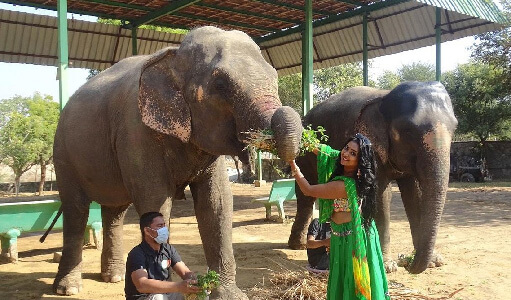
Feeding elephants in Jaipur is a popular visitor activity because it allows people to stand close to an elephant without riding or asking for a performance. However, feeding should still be assessed carefully.
Ask what food visitors are giving and how it fits into the elephant's complete diet.
An elephant should not spend the entire tourist day receiving endless high-calorie treats simply because visitors enjoy feeding.
The amount of tourist-provided food should be controlled.
A responsible facility should determine what, when and how much visitors can offer rather than allowing every guest to arrive with arbitrary food.
Feeding can also affect behaviour. Animals quickly learn where food comes from, so visitor sessions need management to avoid creating unsafe expectations around hands, bags and pockets.
Follow staff instructions carefully.
Do not hide extra food, tease an elephant with it or attempt to encourage a pose before giving the food.
The ethical question is not whether feeding occurs. The question is whether it is controlled, nutritionally appropriate and managed around the elephant's needs rather than becoming constant entertainment.
A facility should be able to explain the elephant's broader feeding routine, not only the small portion tourists see.
Elephant bathing is often marketed as a gentle, intimate tourist activity. Photographs can look appealing, but visitors should examine how the activity actually works.
Water access and bathing can form part of elephant care, particularly in warm conditions. The concern arises when an elephant is required to enter a particular bathing position repeatedly for successive groups regardless of its own behaviour or environmental conditions.
Ask whether bathing depends on weather, the elephant and the day's routine.
If a facility guarantees a highly staged bathing session to every visitor at every time of year, that should prompt questions.
Travellers should also avoid activities that become rough or intrusive simply because they are described as “washing.”
An elephant does not need a dozen strangers simultaneously scrubbing, climbing around or splashing it for a visitor photograph.
A welfare-focused activity should be controlled and should allow the elephant's response to influence what happens.
Visitors should therefore treat elephant bathing in Jaipur as an activity that needs context rather than assuming it is automatically responsible because no riding occurs.
Painting can refer to very different activities, which makes the terminology important.
There is a major difference between painting decorative colours on an elephant and requiring an elephant to hold a brush and create a painting for human entertainment.
Travellers concerned about performances should ask exactly what is meant when a website lists painting.
If visitors are applying decorative colour, ask what materials are used, how much is applied and whether the elephant can move away.
Products used around an animal's skin should be appropriate and managed carefully.
If the elephant itself is expected to hold a brush and repeatedly produce pictures for visitors, the activity should be evaluated as a trained performance rather than simply being accepted as enrichment because the word “painting” sounds creative.
Again, the broader principle is useful: does the activity exist primarily for the elephant's welfare, or is the animal being required to perform a repeatable tourist product?
Visitor volume has a direct effect on the character of an elephant experience.
A facility processing very large numbers of tourists may have difficulty providing slow, individualised interactions without repeatedly directing elephants from one activity to another.
Ask how many visitors interact with an elephant at one time.
Small groups can allow staff to supervise behaviour more carefully and explain the elephant's routine in greater detail.
Visitors also have more opportunity to observe rather than compete for photographs.
Large group size is not automatic proof of poor welfare, but it creates additional management pressure and deserves attention.
The daily number of sessions matters too. An elephant participating in one controlled visitor period has a different routine from an animal expected to receive groups continuously from morning until evening.
Travellers looking for a responsible elephant experience in India should therefore ask not only how long their own visit lasts but how many similar visits the elephant experiences in the same day.
Online reviews are useful, but most travellers read them incorrectly when evaluating elephant welfare.
A five-star review saying “amazing photos” tells you that the visitor enjoyed the experience. It does not necessarily tell you whether the elephants were managed responsibly.
Search reviews for specific details.
Do visitors mention rides? Do they describe performances? Are elephants chained during interactions? Do multiple reviewers mention pressure to participate in certain activities?
Look at negative reviews as well as positive ones.
A complaint that “the elephant walked away and we couldn't finish our photos” may actually reveal something positive if the facility allowed the animal to disengage.
Conversely, repeated praise that elephants performed the same amusing trick for every group may raise a welfare question.
Recent photographs can also help identify changes in practices.
Do not rely on one dramatic review. Look for patterns across many visitor accounts and compare them with the facility's own current information.
A business can change over time, so an old review should not automatically define present practice.
Several warning signs deserve additional investigation.
A facility that describes itself as a genuine elephant sanctuary while heavily promoting riding should immediately prompt questions.
Guaranteed tricks, performances or staged behaviours are another concern for travellers seeking a non-performance experience.
Lack of transparency is equally important. If simple questions about elephant origin, daily routine, restraints or veterinary care receive vague marketing answers, do more research before booking.
Pressure to pay immediately can also be a warning sign.
Travellers should have enough time to read the booking conditions, cancellation terms and exact activities included.
Extremely cheap prices deserve examination when the experience claims to include hours of individual attention, food, transport and substantial animal care. Elephant care is expensive, so responsible facilities have real operating costs.
At the opposite extreme, a high price does not automatically prove ethical practice.
Price should never replace welfare research.
Before making a reservation, travellers should be able to get clear answers to the following questions:
Do you offer elephant rides? A direct answer is more useful than vague language about traditional experiences.
Do elephants perform tricks or shows? Ask whether any activity requires repeated trained entertainment behaviour.
How many hours per day are elephants involved with tourists? This reveals more than simply asking how long one visitor session lasts.
How many visitors interact with one elephant at a time? Group size affects the intensity of interaction.
Can an elephant walk away from an activity? Genuine choice matters.
When and why are restraints used? Ask about both visitor hours and the rest of the day.
Where did each elephant come from? Look for a clear explanation rather than only the word rescue.
What veterinary care is available? Long-term healthcare is central to welfare.
What happens when an elephant does not want to participate? The answer reveals whether the schedule serves tourists or animals.
What exactly is included in the visitor experience? Know what you are paying for before arrival.
A facility willing to discuss these questions openly gives travellers much more useful information than one relying only on emotional photographs.
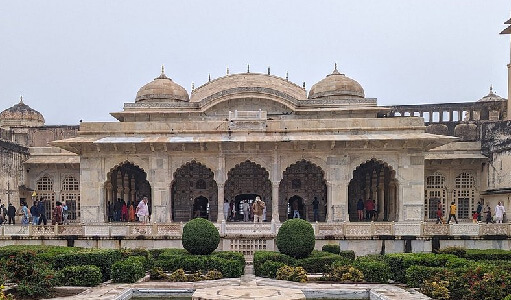
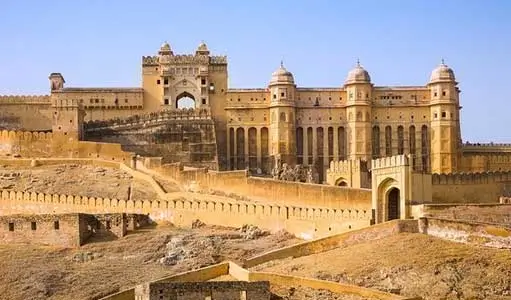
Jaipur is one of India's best-known destinations for elephant-related tourism because of the long historical association between elephants and the Amber area.
That history also makes careful selection especially important.
Visitors may encounter different types of elephant experiences around Jaipur, ranging from riding-oriented tourism to facilities presenting themselves as welfare-focused alternatives.
Travellers should compare practices rather than assuming all elephant attractions near Amber are equivalent.
Elefantastic follows a no-riding, no-performance approach. Visitors interested in spending time beside elephants can consider this type of experience instead of using an elephant as transportation.
A Jaipur itinerary should also allow enough time. Amber Fort itself deserves several hours, and an elephant experience should not be treated as a ten-minute roadside stop.
Visitors staying around Amber or Amer Road can reduce travel time, while travellers based in the Pink City, C-Scheme or Bani Park can reach the area by private car.
Prior reservation is sensible because a responsible animal experience should manage visitor numbers rather than depend entirely on unlimited walk-in traffic.
Ethical tourism is not only the responsibility of the sanctuary. Visitor behaviour matters too.
Follow staff instructions around elephants. Do not approach from an unexpected direction, stand in restricted areas or attempt to create a photograph that staff have advised against.
Do not bring unapproved food.
Avoid shouting, sudden movements or trying to make the elephant respond for a video.
If an elephant moves away, respect the distance.
Visitors should also resist the temptation to demand every advertised interaction. Weather, health or an individual elephant's behaviour may change what is appropriate on a particular day.
A responsible traveller should prefer an activity being cancelled over an animal being forced to participate.
Ask questions while visiting. A good elephant experience should leave visitors knowing more about elephant behaviour, care and welfare than they knew when they arrived.
The most meaningful photograph should be a result of the visit, not the reason every activity exists.
Look beyond the word sanctuary. Check rides, performances, restraints, visitor numbers, elephant routines, animal histories, veterinary care and transparency before booking.
Travellers seeking a welfare-focused experience commonly choose facilities with a no-riding approach rather than attractions using elephants as tourist transportation.
No. Visitor activities, management practices and welfare approaches can differ significantly. Compare the actual practices of each facility before paying.
A single photograph does not provide enough context. Ask when, why, how and for how long restraints are used, including outside visitor hours.
Feeding can be appropriate when the food, amount and interaction are controlled according to the elephant's diet and safety requirements. Unlimited tourist feeding should raise additional questions.
It depends on how the activity is managed. Visitors should ask whether bathing depends on weather and the elephant's behaviour rather than being forced as a guaranteed performance for every group.
Ask where the elephant came from, how it arrived at the facility and what its long-term care arrangement is. The word rescue alone does not explain the animal's history.
The ability to disengage can be an important indicator of how much choice an elephant has during visitor interaction.
Elefantastic follows a no-riding, no-performance approach, focusing on appropriate interaction beside elephants rather than using them for transportation or shows.
A major warning sign is a facility using strong ethical sanctuary language while simultaneously promoting rides, repeated performances or other entertainment-focused activities without transparent explanations of elephant care.